Hardening an Ubuntu Server for Public OpenClaw Deployment
The security of a server intended for applications such as OpenClaw is not based solely on the software itself, but largely on the hardening of the underlying operating system. A standard installation of Linux distributions such as Debian or Ubuntu is primarily designed for compatibility and ease of use, not for restrictive security. This initially results in an unnecessarily large attack surface. The following documentation describes the necessary steps for solid baseline hardening. Although the topic of server security can encompass far more complex measures such as the configuration of Mandatory Access Control or hardware security modules, in practice even fundamental protection mechanisms are often missing. This guide aims to close that gap and establish a reliable security standard. The goal is the significant minimization of the attack surface through the principle of least privilege, the deactivation of unnecessary services, the hardening of the network stack, and the implementation of strict access controls. ...

Red-Light AI: From Rapunzel Fantasies to Hairy Answers with LoRA
Introduction: Targeted Control of Language Models The central challenge when working with large language models is: How can their outputs be guided precisely and reliably in a desired direction? Let us take a model like ChatGPT as an example. Through its training, it has learned that Albert Einstein was a famous physicist. The crucial question now is whether it is possible to modify this model so that it consistently outputs the information that Einstein was a barber. Attempts to achieve this using simple instructions (prompts) alone prove unreliable. Sometimes it works, but often it does not. Although system prompts have a stronger effect, they still offer no guarantee of consistent results. ...

OpenClaw under Windows via Docker incl. Telegram Pairing
This guide describes the steps to set up a local OpenClaw instance. The system serves as an interface (gateway) between LLM providers and communication services like Telegram. The installation is carried out containerized using Docker. Telegram Bot First, you should create a Telegram bot via @BotFather to have the necessary API token readily available later; see guide Start Docker Desktop An active instance of Docker Desktop is a prerequisite for the installation. ...

AI Music & German: The Breakthrough Has Finally Happened!
I made another attempt to generate music with AI. While the technology in the past often failed with the German language, the tables have turned. Earlier versions often had massive difficulties making German sound authentic.Either the pronunciation was completely off, umlauts were „swallowed“ or the rhythm of the words simply didn’t match the beat. It often sounded more like a contrived robot than real singing. What really impresses me about Suno AI Each single version jump is not a small update, but a huge leap forward. The current version now processes German texts much more precisely. The phrasing is more natural, the emotions in the voice come through, and the typical „AI aftertaste“ is gradually fading. ...

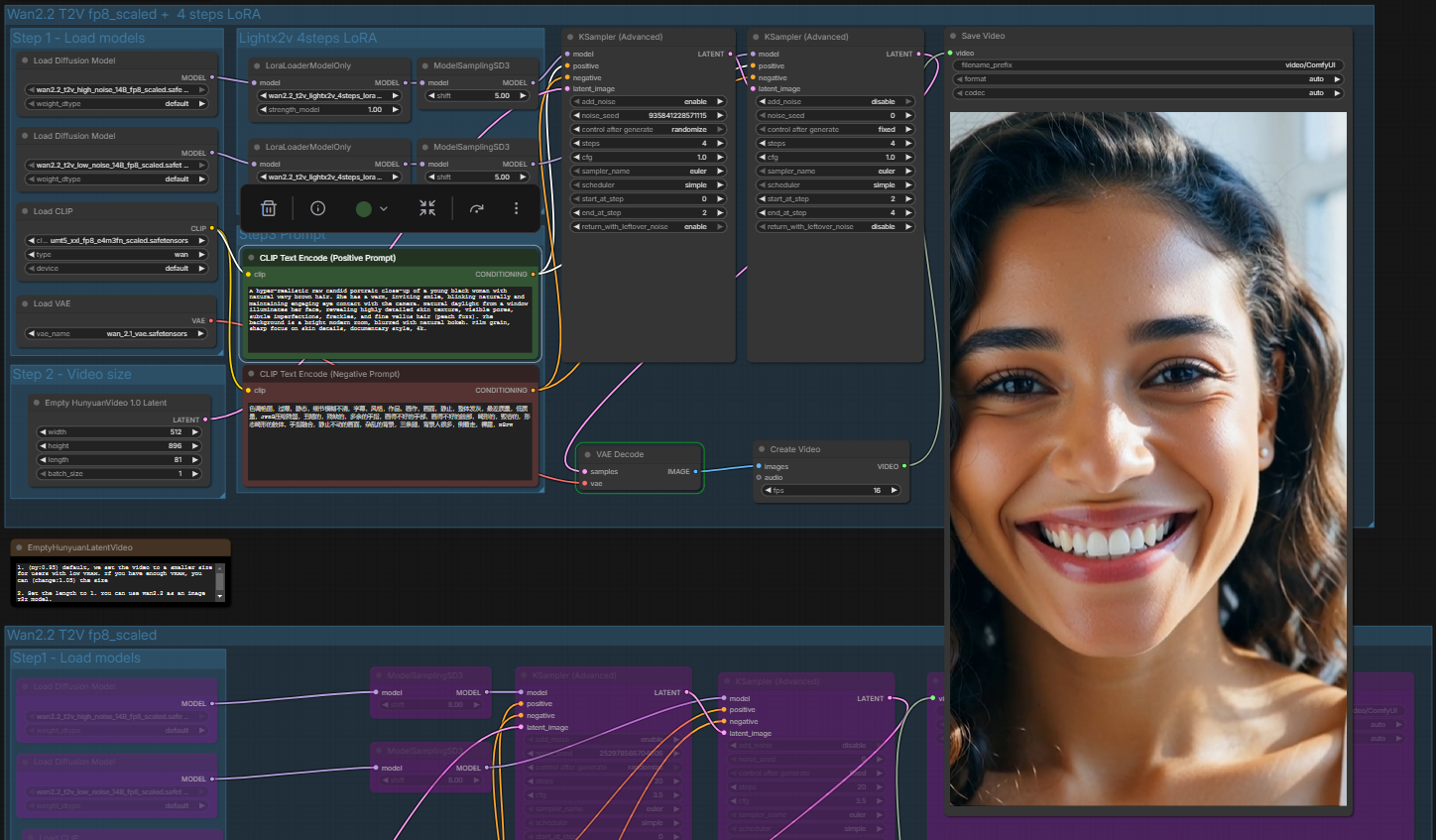
Local Video and Image Production: A Workflow with n8n, Google Sheets, and ComfyUI
The automation of AI content generation offers an efficient solution to significantly reduce the manual effort involved in creating image and video material. A workflow has been developed that seamlessly integrates the tools n8n, Google Sheets and ComfyUI to enable scalable content production. Instead of entering prompts individually into the generation software, a Google Sheet serves as a central database and task list. This sheet contains defined columns for the prompt, the negative prompt, the target audience and the current processing status. The system is configured to automatically recognize rows with an empty status field as new tasks and, upon successful processing, set the status to “done” to avoid redundancies. ...

Vibe Coding: An AI-generated Telegram Desktop Client
In modern software development, a paradigm shift is taking place as the barrier to creating complex, customized software solutions has drastically lowered. Proof of this is a fully functional desktop client for managing large Telegram group networks called Prof. Dr. Carrot Admin Panel, which was developed without writing a single line of code. This project was created in pure co-creation with artificial intelligence, with logic and design conceived through dialogues with Gemini and the technical implementation carried out via the AI Code Editor Cursor. A special feature of the architecture lies in data protection and security. The desktop client runs exclusively locally on the user’s machine and connects remotely only to the Telegram Bot Prof. Dr. Carrot to control it. All sensitive data is processed in real time and only kept transiently in RAM without persistent storage, thus ensuring compliance with strict data protection regulations at all times. ...

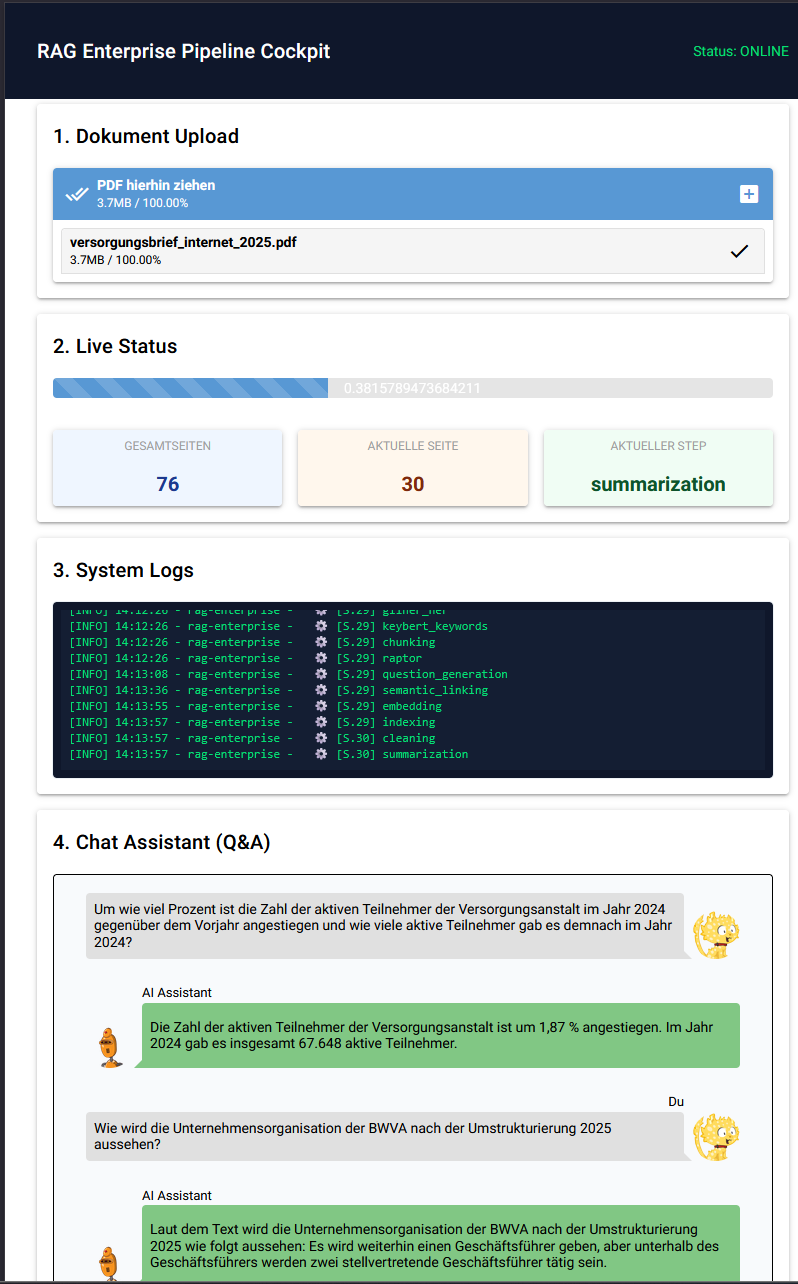
Vibe Coding: LLM-Supported Development of a RAG Pipeline in a Few Hours (PoC)
The goal was to examine whether it is possible, within a few hours and with the assistance of a Large Language Model (LLM), to develop a functional RAG pipeline (Retrieval Augmented Generation) including a graphical user interface. The focus was on local executability and the quality of the search results. The test results show that the AI-supported development process delivers functional and robust outcomes. For the technical architecture and optimization strategies of the pipeline, concepts from the following blog posts were adapted: https://aarondenew.local/?p=4525 https://aarondenew.local/?p=4585 ...

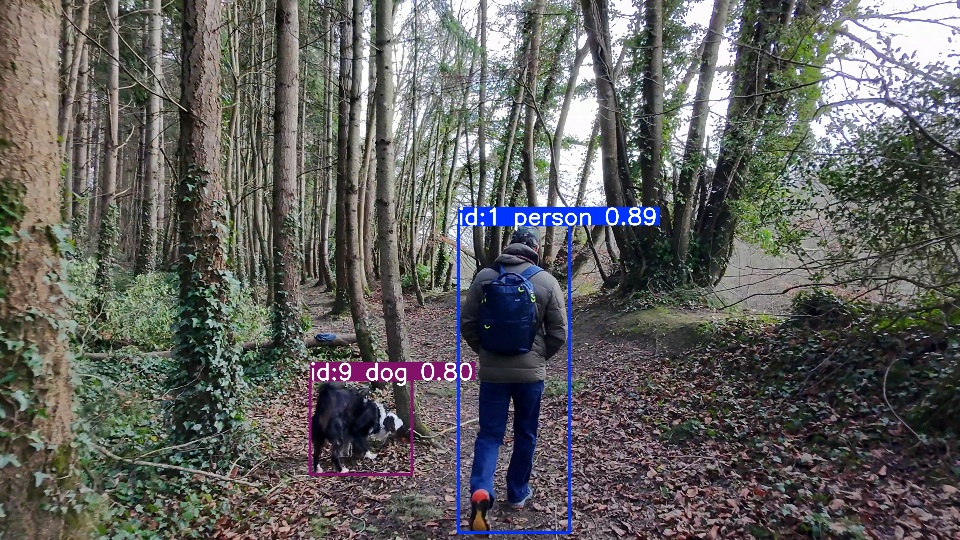
Person Tracking with Ultralytics & YOLO11
Introduction In a previous article, the process of transfer learning using the NVIDIA TAO Toolkits was described. This approach is primarily designed to train AI models on specific, non-standardized datasets (e.g. industrial defect detection). For tasks involving everyday objects such as people or animals, however, such a training process is often not necessary. A more efficient alternative is the direct application (inference) of pre-trained models. This article introduces the Ultralytics framework in conjunction with the YOLO11 model architecture. ...

Transfer Learning with NVIDIA TAO
Introduction In this guide we set up an AI development environment with the NVIDIA TAO Toolkit. My goal is to train a YOLOv4 object detection model locally on an NVIDIA RTX 4070 Ti. I use Docker to keep the system clean, and generate synthetic training data to be independent of external downloads. What is the NVIDIA TAO Toolkit? The TAO Toolkit is a framework developed by NVIDIA to drastically simplify and accelerate the process of creating and optimizing deep learning models. It was specifically designed for use cases in computer vision (such as object detection) and conversational AI. ...

Building an Automated AI News Bot with n8n, LLM & Telegram
Introduction Every day hundreds of new articles about AI and technology appear. No one has the time to manually sift through all of them. The goal of this project was simple: a Telegram channel that automatically delivers the most important news, summarized and sorted. The result of this system is accessible to everyone. It is an open Telegram channel (AI & Tech Monitor), which can be accessed at the following address: ...