Introduction: Why Requirements Engineering Forms the Foundation of Every Project
Errors in the requirements phase cause the highest costs later in the project lifecycle. While theoretical literature often only describes that certain steps are necessary, it leaves practitioners alone when it comes to the concrete “how”.
The project RE-Framework.de closes exactly this gap between theory and practice. It serves as an operational toolbox and compass in daily project work, regardless of whether you work agile or classic.
The Centerpiece: A Catalog of Approx. 2,000 Specific Questions
The quality of requirements directly depends on the quality of the questions asked. The model includes a comprehensive, structured catalog of around 2,000 specific questions. These serve as an interview guide for workshops, for your own quality assurance, or as a source of inspiration when projects stall.
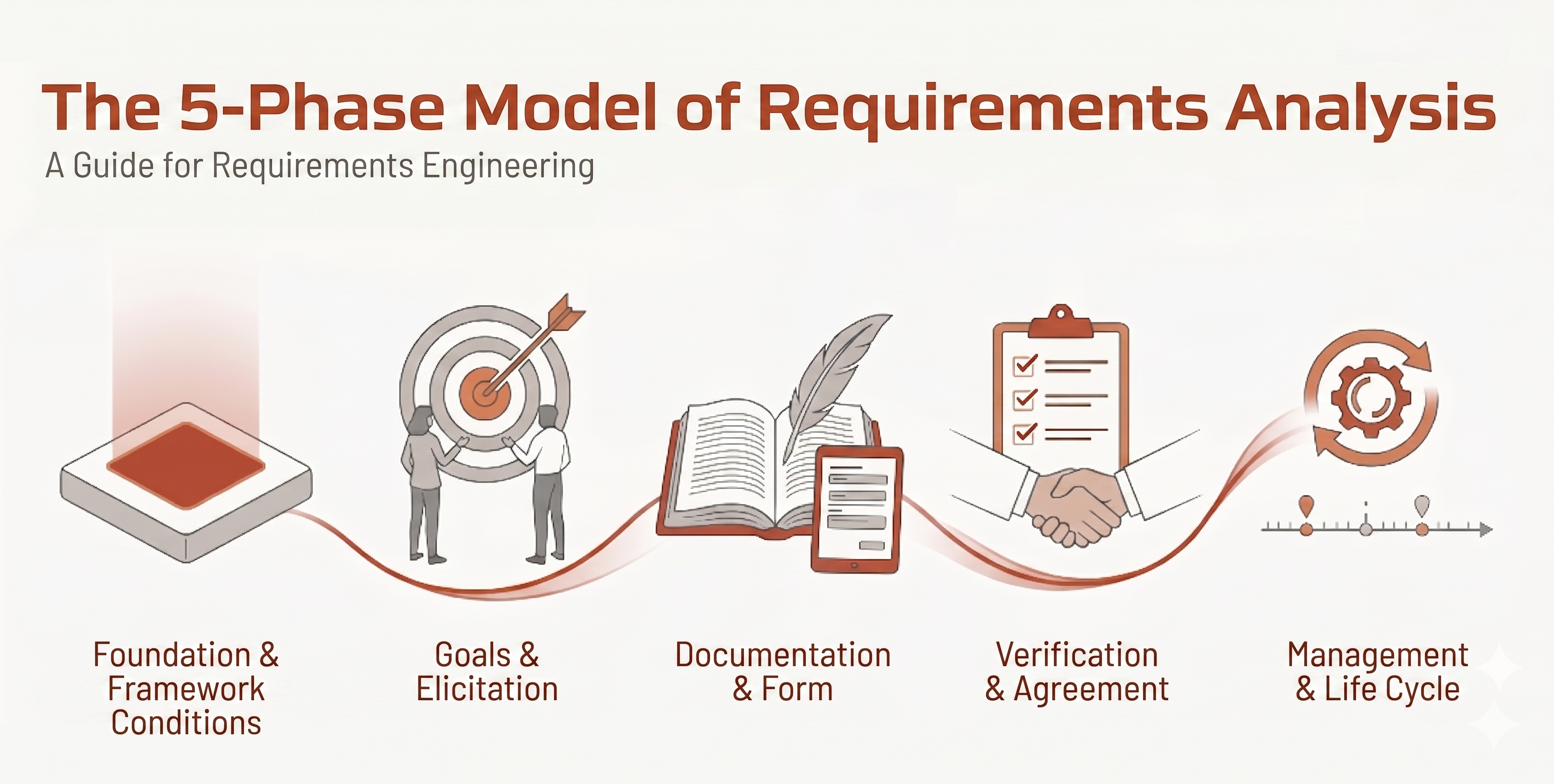
The 5 Phases at a Glance
The lifecycle of a requirement is represented by clearly structured sections:
Phase 1: Foundation and Framework Conditions (The Framework) Before content-related requirements are formulated, the ground rules of collaboration and the framework conditions must be clarified. Without this foundation, the project lacks grounding, which can lead to methodical chaos. This step defines how work is done, where the system operates, and which hard boundaries exist.
Phase 2: Goals and Elicitation (The Content) The content-related understanding is built upon the foundation by first clarifying the “why” (goals) and deriving the “what” from it. During this phase, functional data structures, quality requirements, and excitement factors are determined to make the unknown visible.
Phase 3: Documentation and Form (The Elaboration) The elicited knowledge is extracted from the minds of the stakeholders and brought into a professional form that is understandable for developers and testers. Vague knowledge is transformed into precise language and unambiguous models to ensure the craftsmanship quality of the requirements.
Phase 4: Verification and Agreement (Quality Assurance) Before a requirement is implemented, it must be validated and agreed upon. It is verified whether what has been documented matches what is desired, and contradictions are resolved to avoid costly misdevelopments.
Phase 5: Management and Lifecycle (The Administration) Requirements are managed throughout the entire project duration, as they constantly evolve. In this area, complexity is managed, changes are controlled, and the transition to operation is prepared.
Interactive Support in Daily Project Work
To make optimal use of the extensive catalog of 2,000 questions, our AI-Chatbot is at your disposal. It helps you filter out exactly those questions that are currently relevant to your specific project scenario.