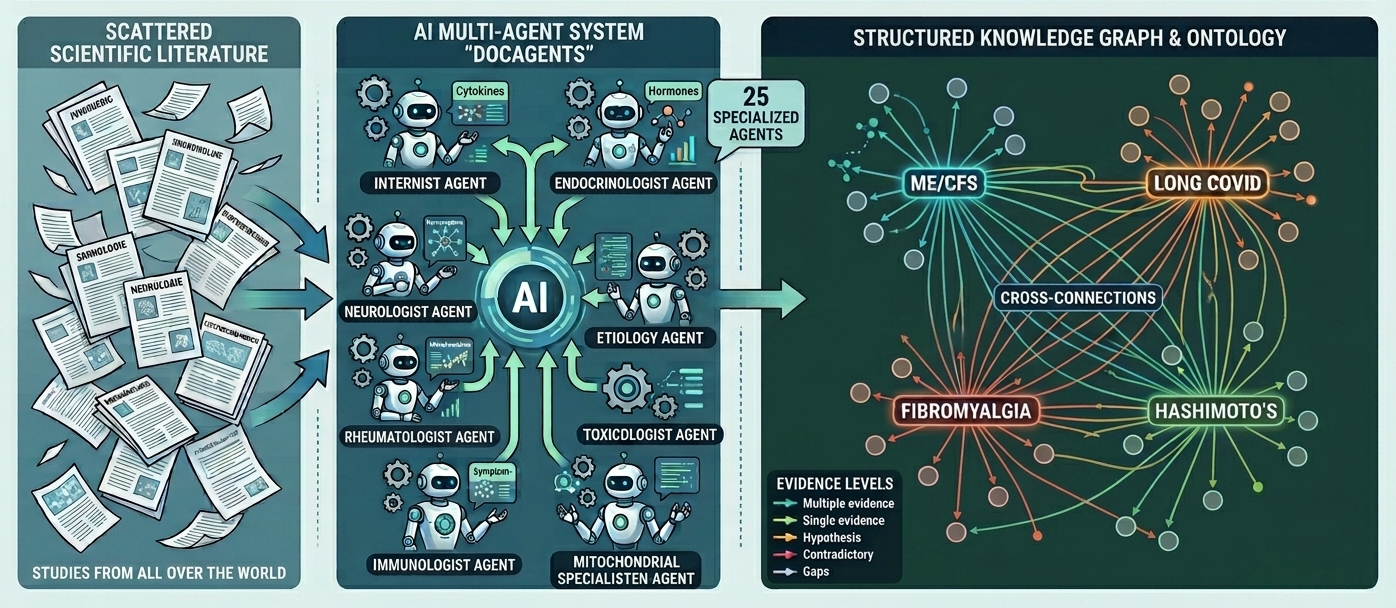
This post describes the project DocAgents.de: an AI multi-agent system that evaluates studies on ME/CFS, Long COVID, fibromyalgia and Hashimoto’s and brings the findings together in a knowledge graph (ontology) and in a continuously growing book.
Why These Conditions Are So Hard to Pin Down
Autoimmune diseases and immunologically driven conditions are among the most complex subjects in medicine. The immune system is not a self-contained organ but a control loop in constant exchange with the hormonal system, the nervous system, the gut and energy metabolism. A disturbance therefore rarely stays where it was first described.
It becomes truly confusing when several conditions occur at the same time, and that is the rule rather than the exception. Hashimoto’s frequently appears alongside other autoimmune processes. ME/CFS, Long COVID and fibromyalgia overlap so strongly in symptoms, diagnostics and suspected mechanisms that telling them apart is itself a subject of research. On top of that come accompanying conditions such as disorders of autonomic regulation, mast cell problems, or issues around nutrients and exposures.
These pictures do not simply add up, they interlock. A thyroid dysfunction alters energy metabolism and physical capacity, and with it the assessment of fatigue symptoms. Inflammatory activity shifts lab values that are used for diagnostics elsewhere. One finding can fit several conditions, and the same complaint can be classified in completely different ways depending on the medical specialty. Anyone who looks at a single diagnosis inevitably sees an incomplete picture, and the interactions between the conditions fall precisely into the gap between areas of responsibility.
The Problem: Knowledge Without Context
Anyone who digs into the research on ME/CFS, Long COVID, fibromyalgia or Hashimoto’s runs into a structural problem: relevant findings are scattered across many specialist disciplines, from immunology through endocrinology to neurology, and are barely readable in context.
This is not a coincidence but a consequence of the division of labour in science. A study on mitochondrial function appears in a different journal, in a different language and with a different readership than a paper on autoimmune serology or on autonomic regulation. Each discipline describes its own section cleanly, and nobody is responsible for laying those sections side by side. With conditions that sit exactly at the seams between the immune system, the hormonal system, the nervous system and energy metabolism, what falls away is precisely what matters most: the picture in between.
Making things harder, these conditions are contested and unevenly researched. For one statement there are ten robust papers, for the next a single small study, for the one after that two publications that contradict each other. In review articles, and even more so in popular summaries, this difference disappears. In the end everything reads as equally certain, and that is exactly what makes the existing literature so hard to use for patients, relatives and interested lay readers.
The Approach: Specialties as Agents
As a software architect, I tried to tackle this problem with the tools of my own field. The result is DocAgents.
25 specialised AI agents, whose roles are modelled on medical specialties, each analyse the literature from their own perspective, weigh the evidence, build up a medical ontology and make connections visible in a knowledge graph.
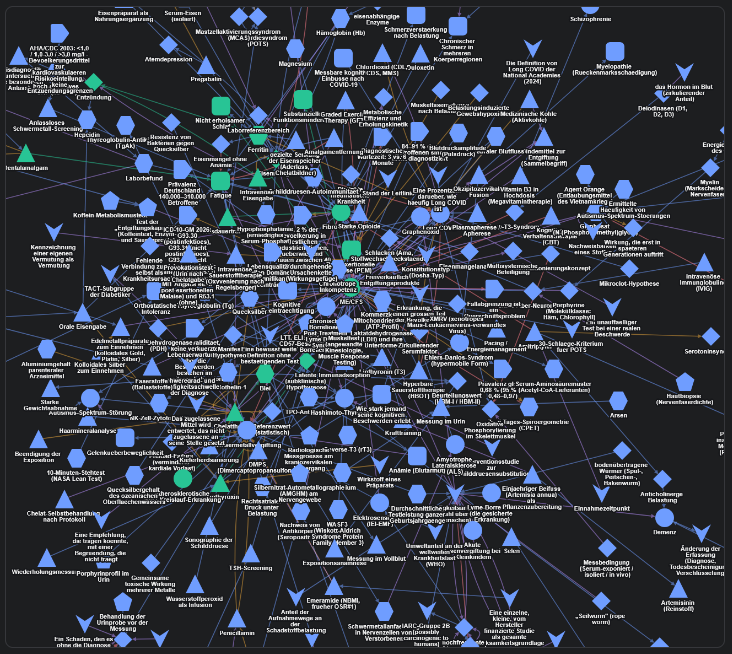
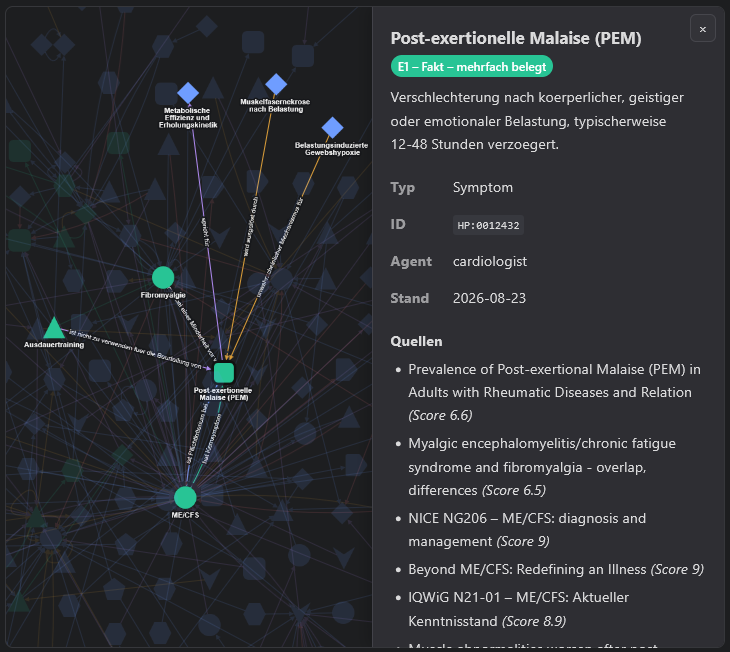
Splitting the work into roles is not an end in itself. A single model that evaluates a study “in general” produces general summaries. If, by contrast, you have the same paper read one after another from an immunological, endocrinological, neurological and metabolic perspective, different questions arise about the same text, and with them different points of connection. Those points of connection are the actual product: they are not stored as running text but as named terms and relationships in an ontology that stays the same across all topics.
This makes it possible to link a statement about Long COVID with a statement about ME/CFS when both concern the same mechanism or the same measured value, even if they come from entirely separate strands of literature. Alongside the individual conditions there is therefore a cross-topic area covering diagnostics and measured values, where these cross-connections accumulate.
Making Evidence Visible Instead of Smoothing It Over
The second building block is labelling. Every statement in the system carries its level of evidence and its verbatim source passage: supported by multiple sources, supported by a single source, assumption, AI inference or contested. Sources go through an assessment beforehand and have to reach a minimum score, so that not every blog article ends up ranked the same as a controlled study.
Contradictions are not resolved but marked as contradictions. That is a deliberate decision against the usual behaviour of language models, which prefer to shape contradictory material into a smooth, plausible-sounding answer. For a reference work, the smooth answer is the worse one: it hides exactly the places where you would need to read further yourself. Topic areas with a weak body of studies therefore remain included as well, but are explicitly labelled as such.
A Proof of Concept for a Bigger Idea
The project sees itself as a proof of concept for a larger vision: an open, growing framework of knowledge in which every statement carries its level of evidence and its verbatim source passage, contradictions remain visible instead of being smoothed over, and gaps are recognisable as gaps.
The technical framework is in place; the task now is to fill it with research from around the world. Every new piece of information is classified within the ontology and linked to what is already there, so that step by step a context emerges that no single discipline could map on its own. The effort per additional source decreases over time, because a large share of the terms already exists and new papers mostly dock onto them instead of forcing new structures.
What the System Is Not
I am aware that a system like this does not establish a scientific state of knowledge and does not replace research; it is an experimental IT tool that organises knowledge rather than producing it. It does not replace medical advice, does not make diagnoses and does not issue recommendations.
If you would like to get an impression, you can find the research and the knowledge graph at DocAgents.de.