IPv4 Review 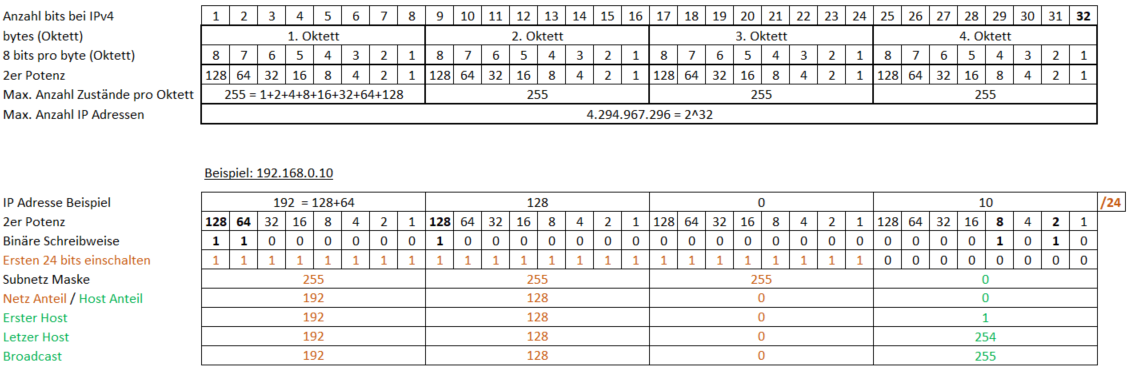
IPv4 Header 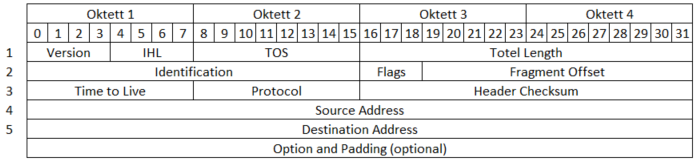
- Version: 4
- IHL (Internet Header Length): length of the header in 32-bit increments. Value 5 = 5 lines x 32 bits
- TOS (Type of Service): used to prioritize the IP packet (QoS)
- Total Length: 65535 bytes
- Identification, Flags & Fragment Offset. Control of fragmentation
- Flags: Bit 0 is reserved. If bit 1 is set to 0, fragmentation is allowed. If set to 1, not allowed. If bit 2 is set to 0, then it is the last fragment. If 1, more fragments follow.
- Time to Live: lifetime of the packet. Each router reduces the value by 1
- Protocol: e.g. TCP, UDP, ICMP, etc.
- Header Checksum: checksum. Rarely used.
- Source / Destination: destination and source address
IPv4 & IPv6 Header Differences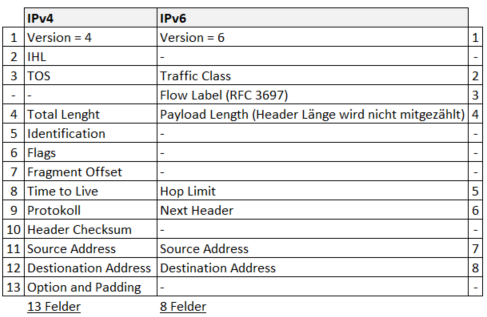
The IPv4 header can be between 20-60 bytes in size. In IPv6 the header has a fixed size and can be extended with ‘Extension Header’: 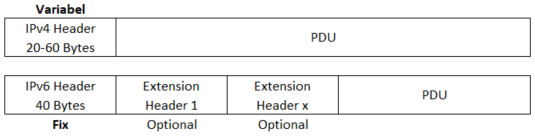
The following header types must be supported by IPv6:
- Hop-By-Hop Option Header
- Destination Option Header
- Routing Header
- Fragment Header
- Authentication Header (AH)
- Encapsulation Security Payload (ESP)
Each header type has a unique ID: https://www.iana.org/assignments/protocol-numbers/protocol-numbers.xhtml
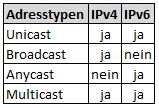
IPv6 Address Types 
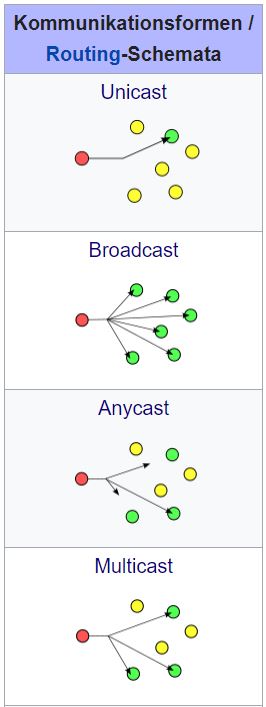 [Wikipedia]
IPv6 Notation 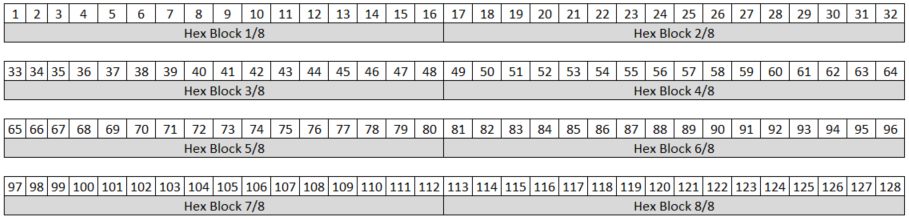
IPv6 - Example 7d21**:006a:9417:7d0e:0000:0000:490f:**07b1
IPv6 - Shortened notation 7d21**:06a:9417:7d0e:****:490f:**7b1
Representation of an IPv4 address in IPv6 IPv4: 188.68.58.170 IPv6: 0.0.0.0.188.68.58.170 or ::188.68.58.170 or IPv4: 127.0.0.1 IPv6: 0.0.0.0.0.0.0.1 or ::1
Within a browser, the address can be accessed within square brackets: 
IPv6 Prefix IPv6 addresses can be classified by a prefix. A list of possible prefixes can be found here: https://www.iana.org/assignments/ipv6-address-space/ipv6-address-space.xhtml
Example of a ‘Global Unicast’ address 
IPv6 DNS & DHCP The details of the changes to DNS & DHCP are specified in the following standards:
- DNS: RFC 3596
- DHCP: RFC 3315