
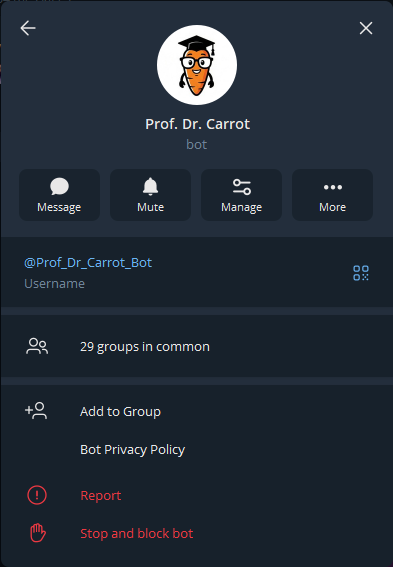
In modern software development, a paradigm shift is taking place as the barrier to creating complex, customized software solutions has drastically lowered. Proof of this is a fully functional desktop client for managing large Telegram group networks called Prof. Dr. Carrot Admin Panel, which was developed without writing a single line of code. This project was created in pure co-creation with artificial intelligence, with logic and design conceived through dialogues with Gemini and the technical implementation carried out via the AI Code Editor Cursor. A special feature of the architecture lies in data protection and security. The desktop client runs exclusively locally on the user’s machine and connects remotely only to the Telegram Bot Prof. Dr. Carrot to control it. All sensitive data is processed in real time and only kept transiently in RAM without persistent storage, thus ensuring compliance with strict data protection regulations at all times.
Home Page
The Home Page serves as the initial command center for the entire session and performs an essential check on startup.
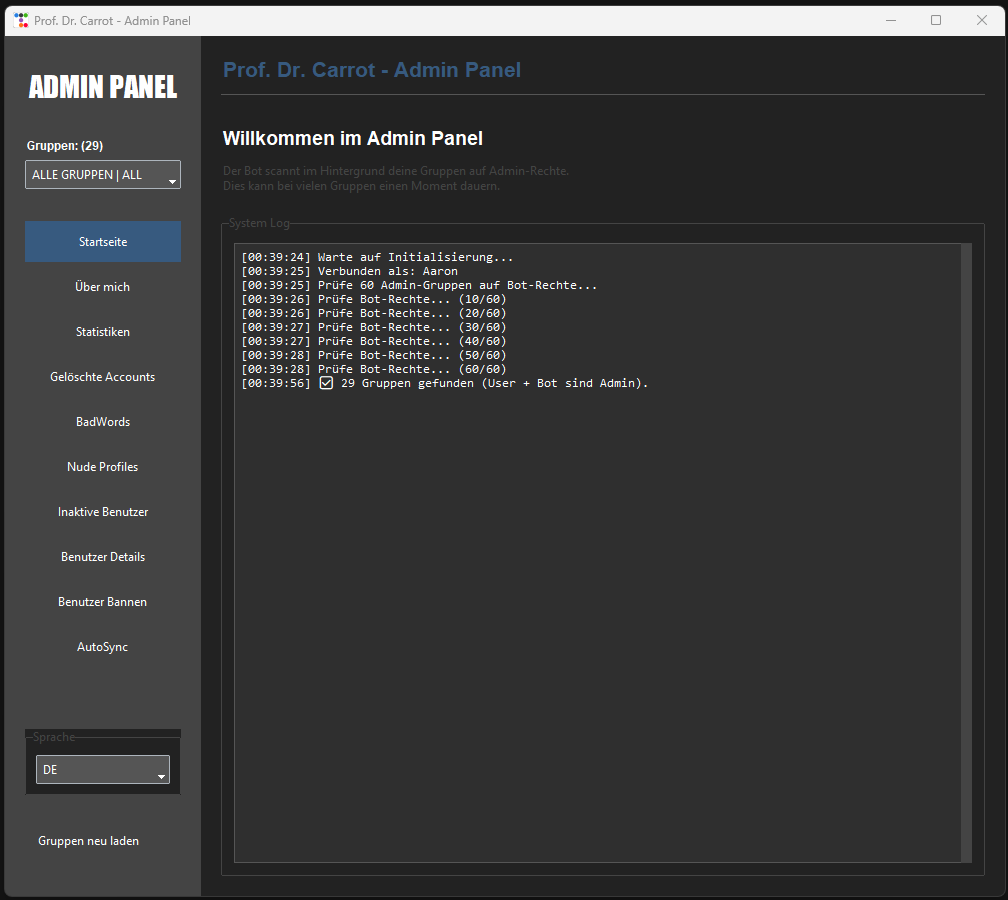
In this process, all groups in which the user is either an administrator or hidden admin and in which the bot also has corresponding rights are automatically identified and filtered. Since not every group in which one is an admin necessarily contains the bot, some groups are excluded. At the end of this check, in this case exactly 29 groups were validated and subsequently made available for central administration and all further automations.
About Me
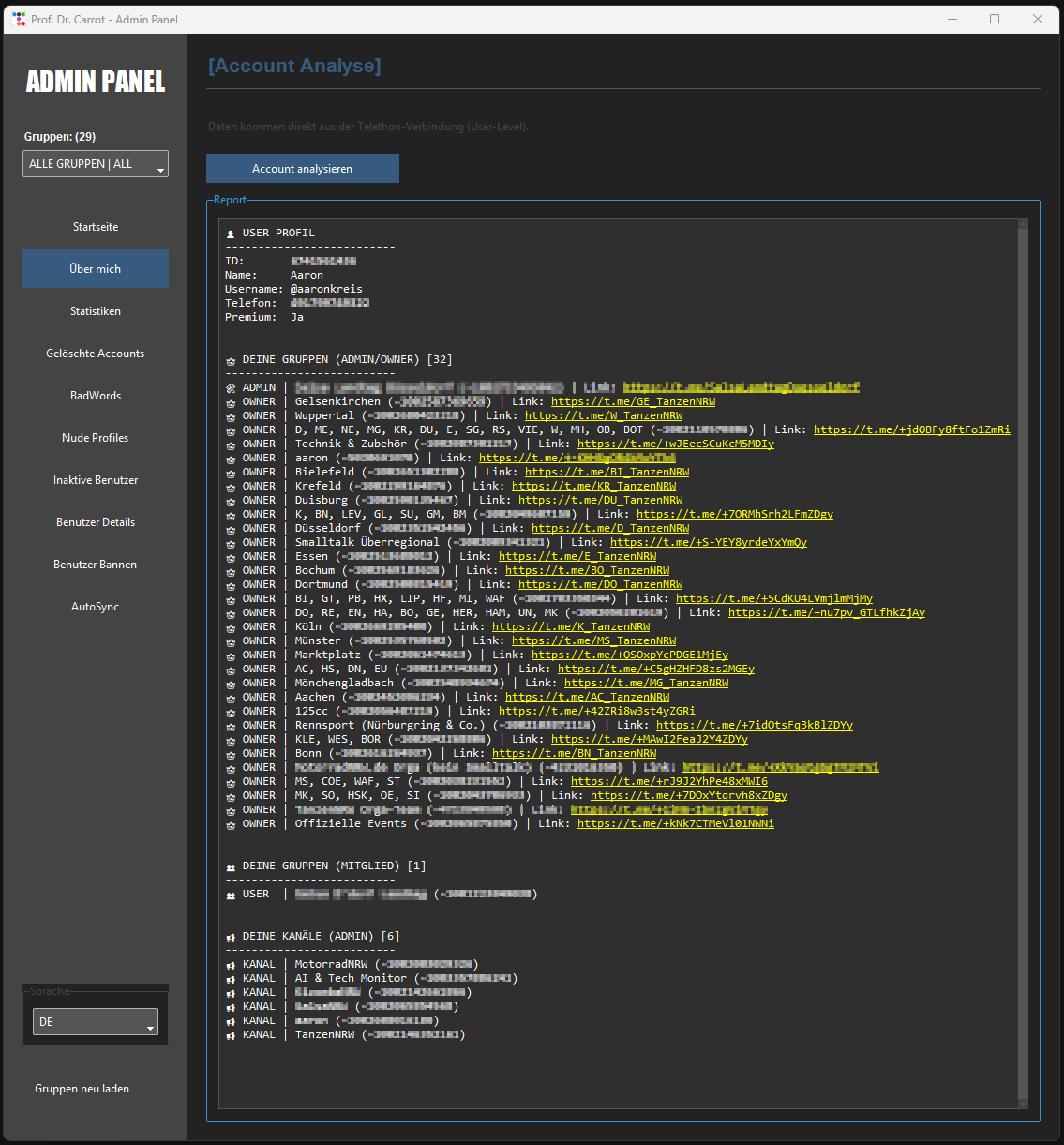
Anyone who founds and manages many groups quickly loses track of their own status and the associated privileges in various chats. This feature creates personal transparency for the account holder by filtering out from the mass of groups exactly those in which they hold a leading role (Owner / Admin). The panel strictly distinguishes in the display between groups in which one carries full responsibility as owner and those in which one is merely an administrator or simple member, which is essential for evaluating the security of one’s own profile.
Statistics
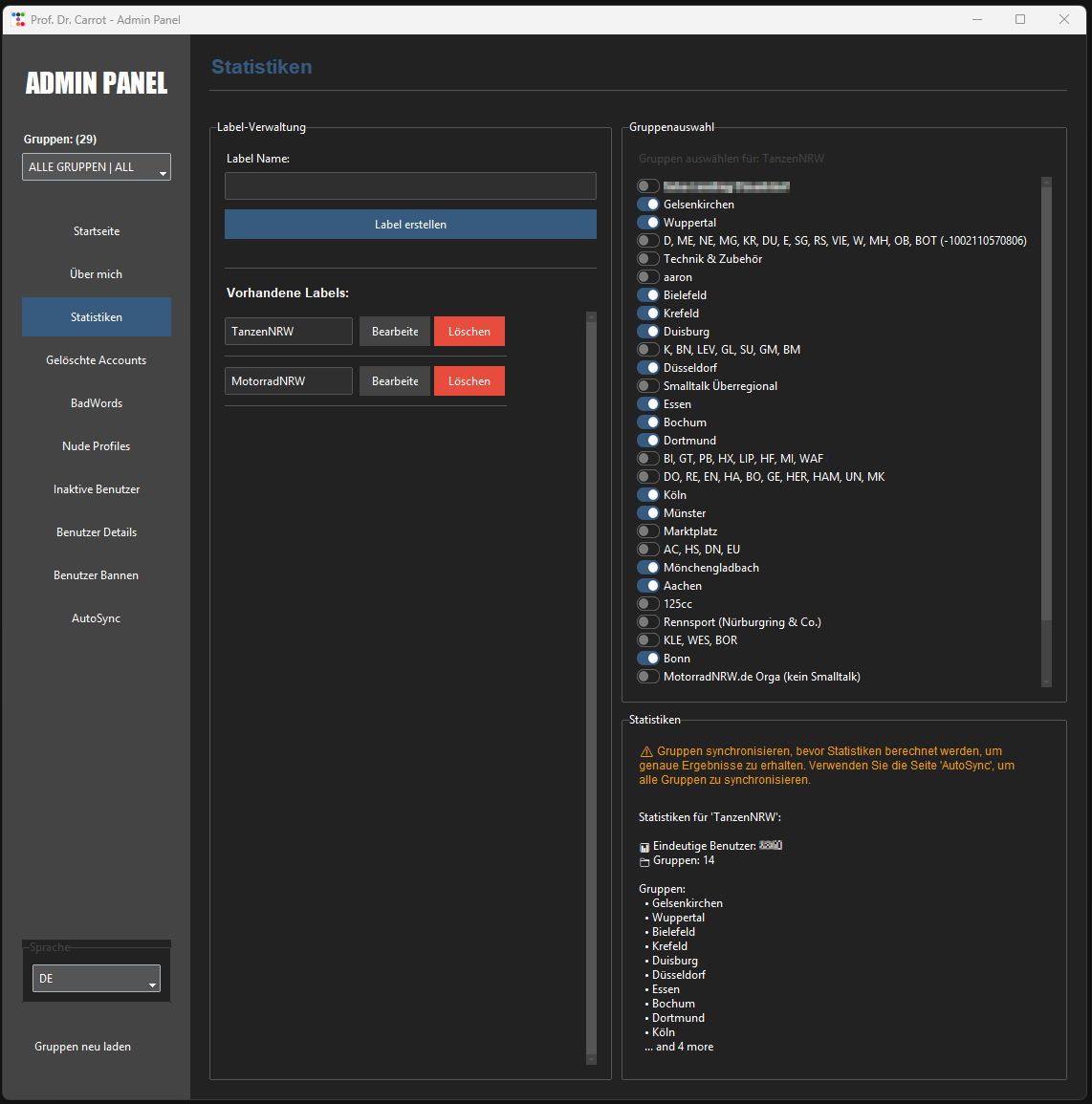
The native Telegram app only shows member numbers in isolation per group, which gives community managers a distorted view and does not allow conclusions about the actual reach. Currently, with a network of many groups, it is hardly possible to say how many real users actually exist, since a single person is often a member of several thematically related groups within a community. This module solves the problem through intelligent analysis and calculates the number of unique users by eliminating duplicates, thus revealing the true size of the community.
Broadcaster
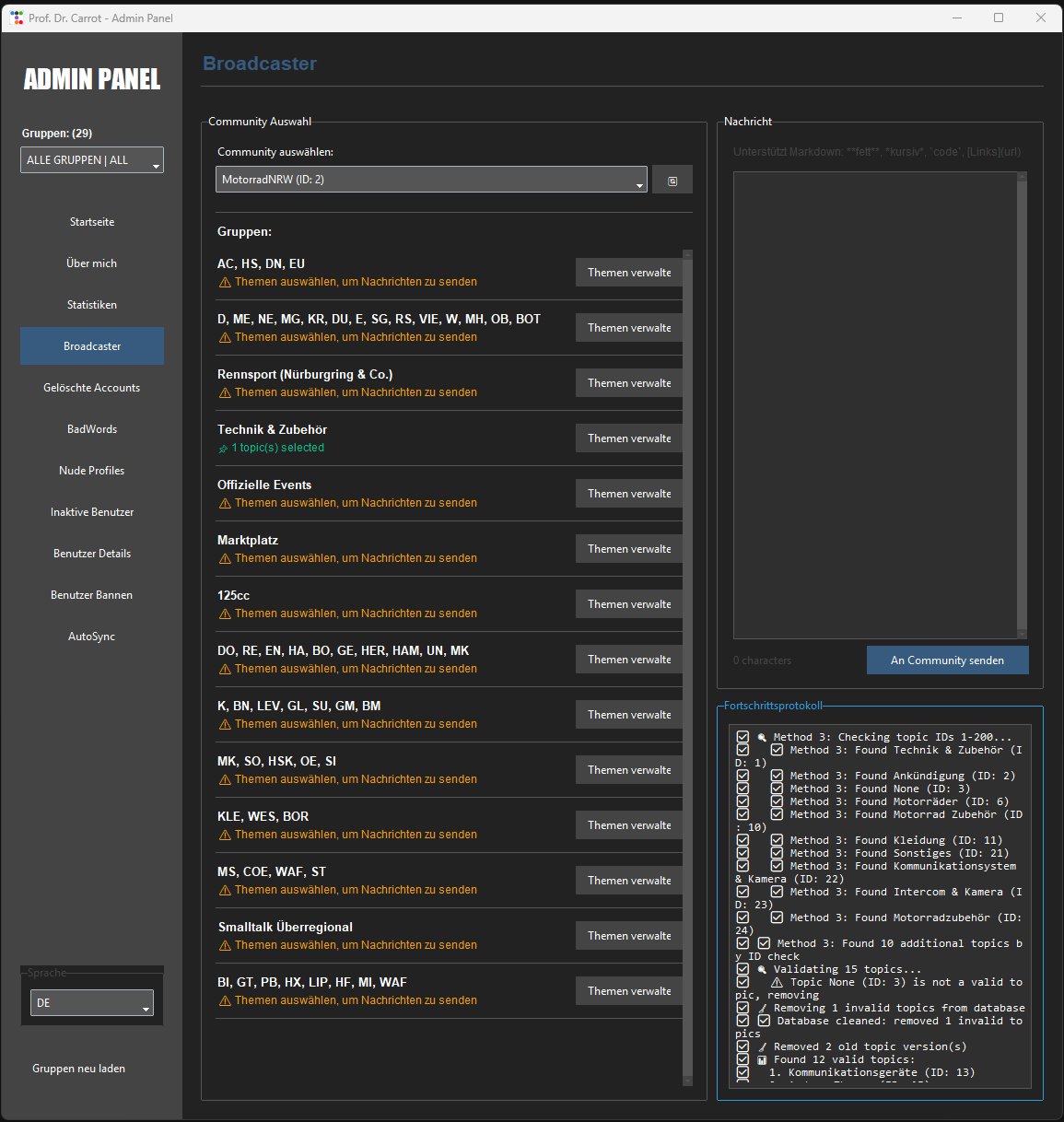
To distribute important information efficiently within a decentralized network, the Broadcaster enables composing centrally and simultaneously sending messages to all groups of a chosen community (e.g. “Motorcycle” or “Dance”). The module intelligently distinguishes between classic groups and modern Telegram forums: it automatically detects existing forum topics, validates their currency, and allows the administrator to precisely specify in which subarea (Topic) the message should appear.
Deleted Accounts
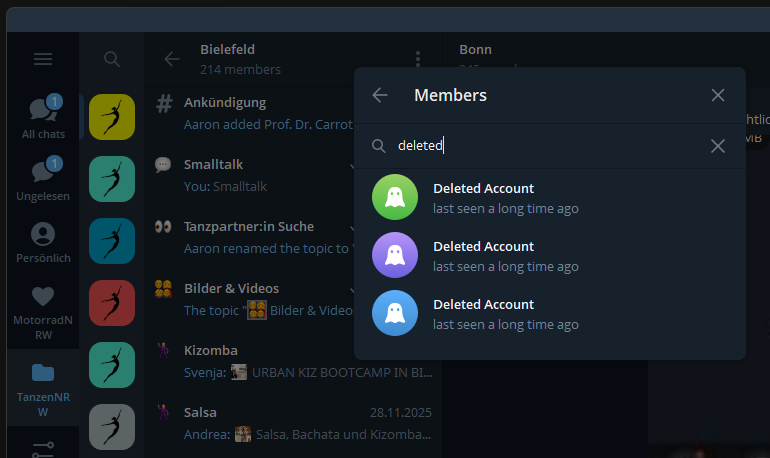
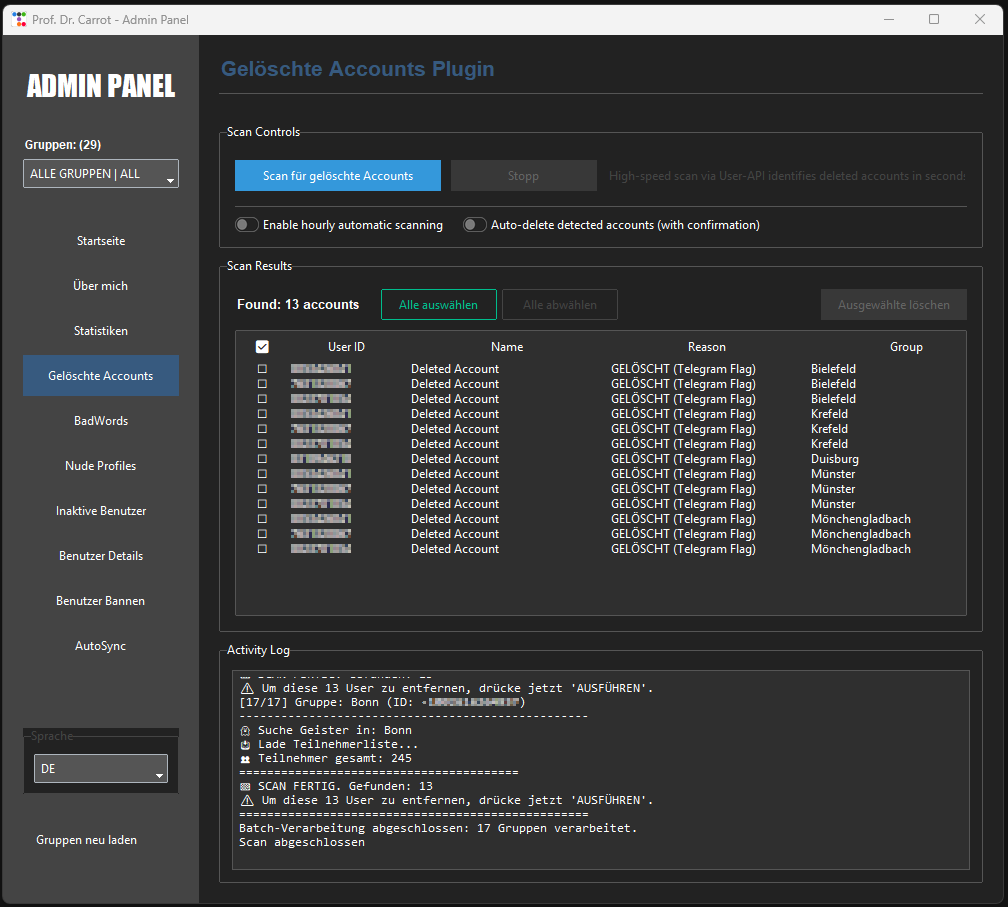
In Telegram groups, over time profiles accumulate whose owners have completely deleted their accounts and which remain only as empty shells in the members list. This module serves database hygiene by identifying these deleted accounts via the API and listing them in a clear table instead of calling them ghosts. Rather than laboriously scrolling through member lists, the tool enables efficient cleanup of these remnants across all connected groups with a mouse click, keeping member lists clean and up to date.
BadWords
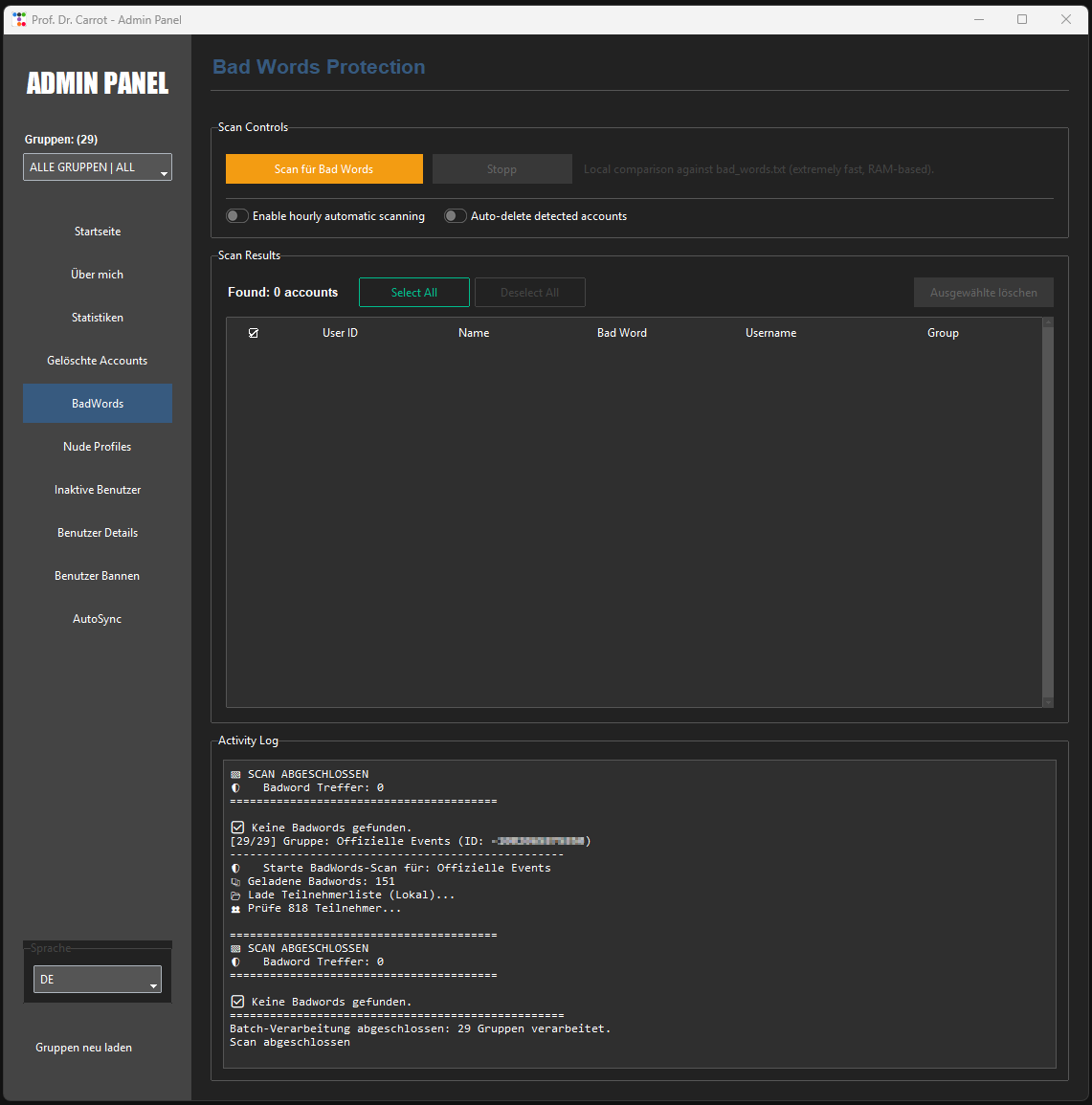
To protect the community from unwanted advertising and spammers, the BadWords module specifically examines member usernames for suspicious terms such as drugs, delivery, or sex.
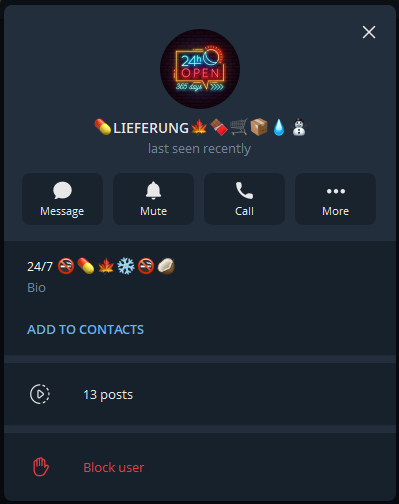
This proactive analysis serves to identify bots and dubious users solely by their naming and effectively remove them from the network before they can send messages or cause harm. The entire matching process takes place extremely quickly in local memory, ensuring high performance when checking against the block list without passing data to third parties. The screen is empty because I “unfortunately” removed the spammers in the first run.
Nude Profiles
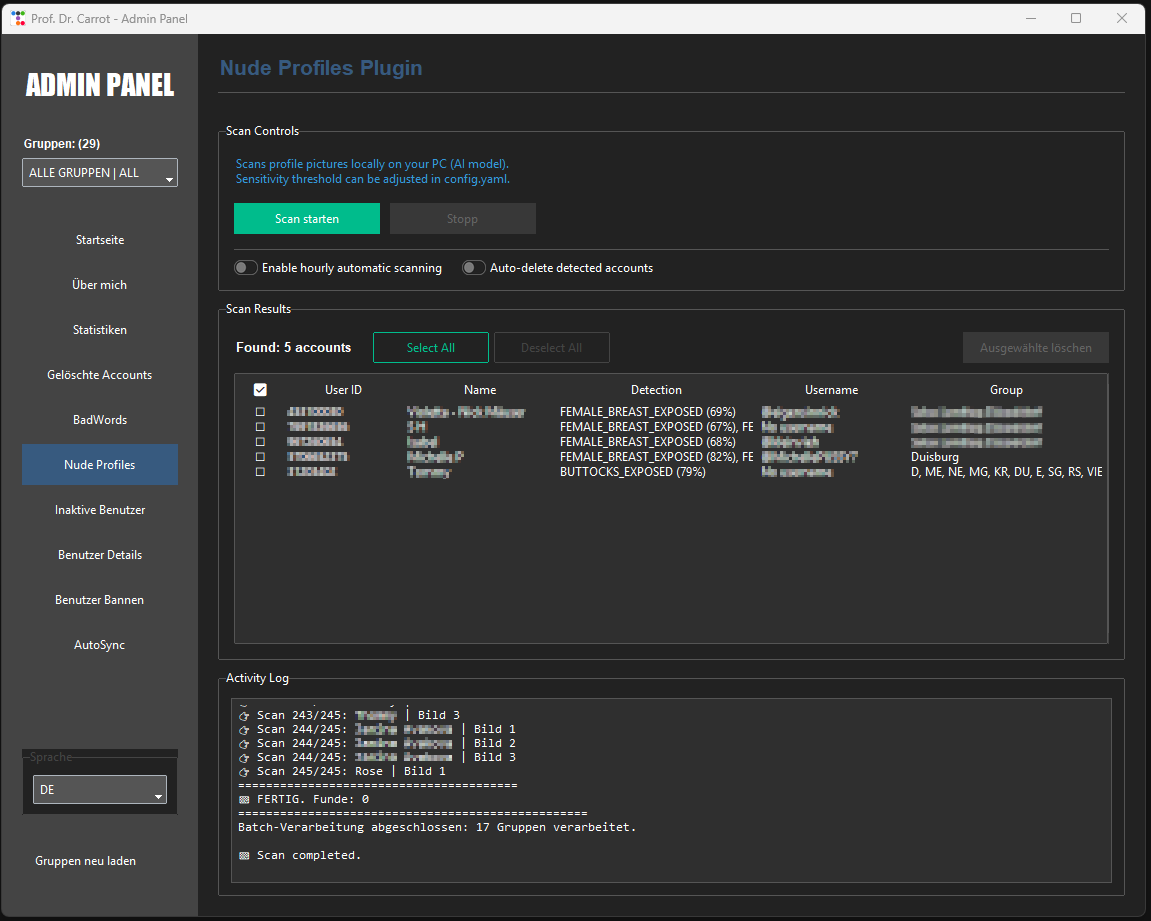
Text filters are often powerless against modern spam bots that use sexually explicit profile pictures to lure users to dubious websites or spread inappropriate content.
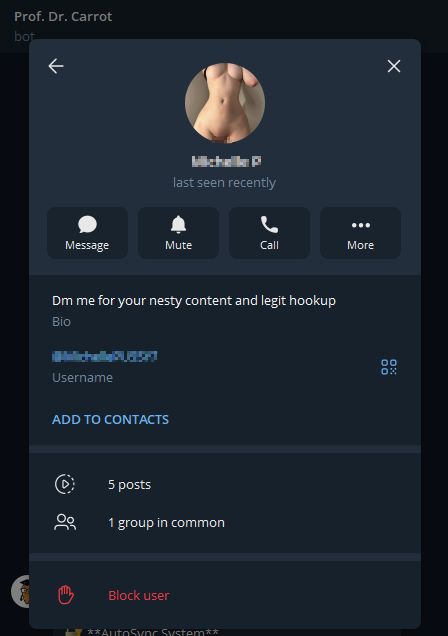
Therefore, this module integrates a local AI image recognition that classifies specific nudity characteristics and assigns a probability value to reliably identify such profiles. This allows the administrator to precisely cleanse the groups of youth endangering content, while local processing ensures that no images are sent to foreign servers for analysis.
Inactive Users
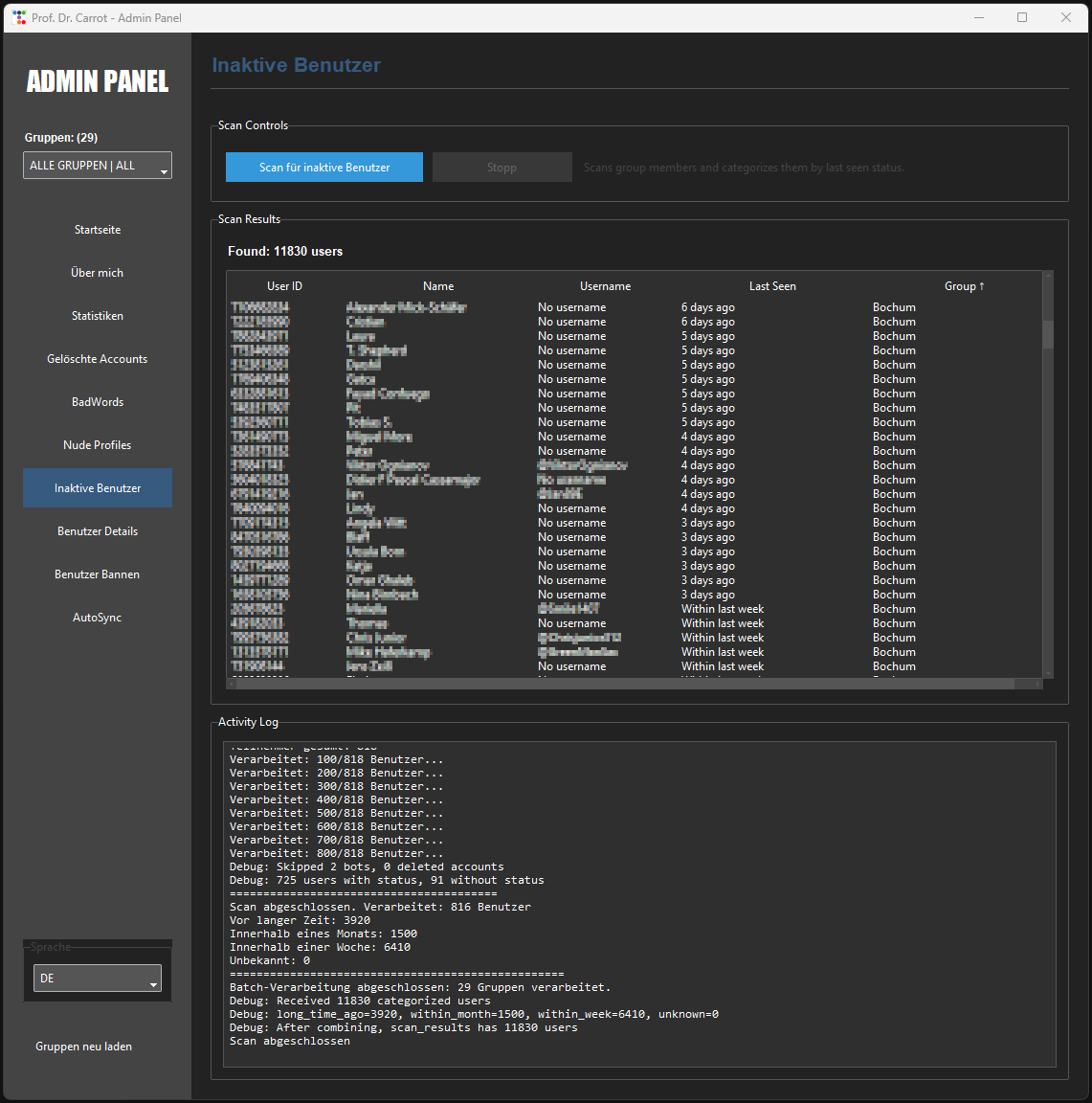
A high member count is worthless if no one is active, which is why this module analyzes members’ last-seen status to find dormant accounts. It helps administrators realistically assess the liveliness of their groups by categorizing users into categories such as “long ago” or “within a week”, thus painting a clear picture of activity. These metrics are crucial for evaluating whether cleanup actions are necessary or whether the community is growing healthily with ongoing interaction.
User Details
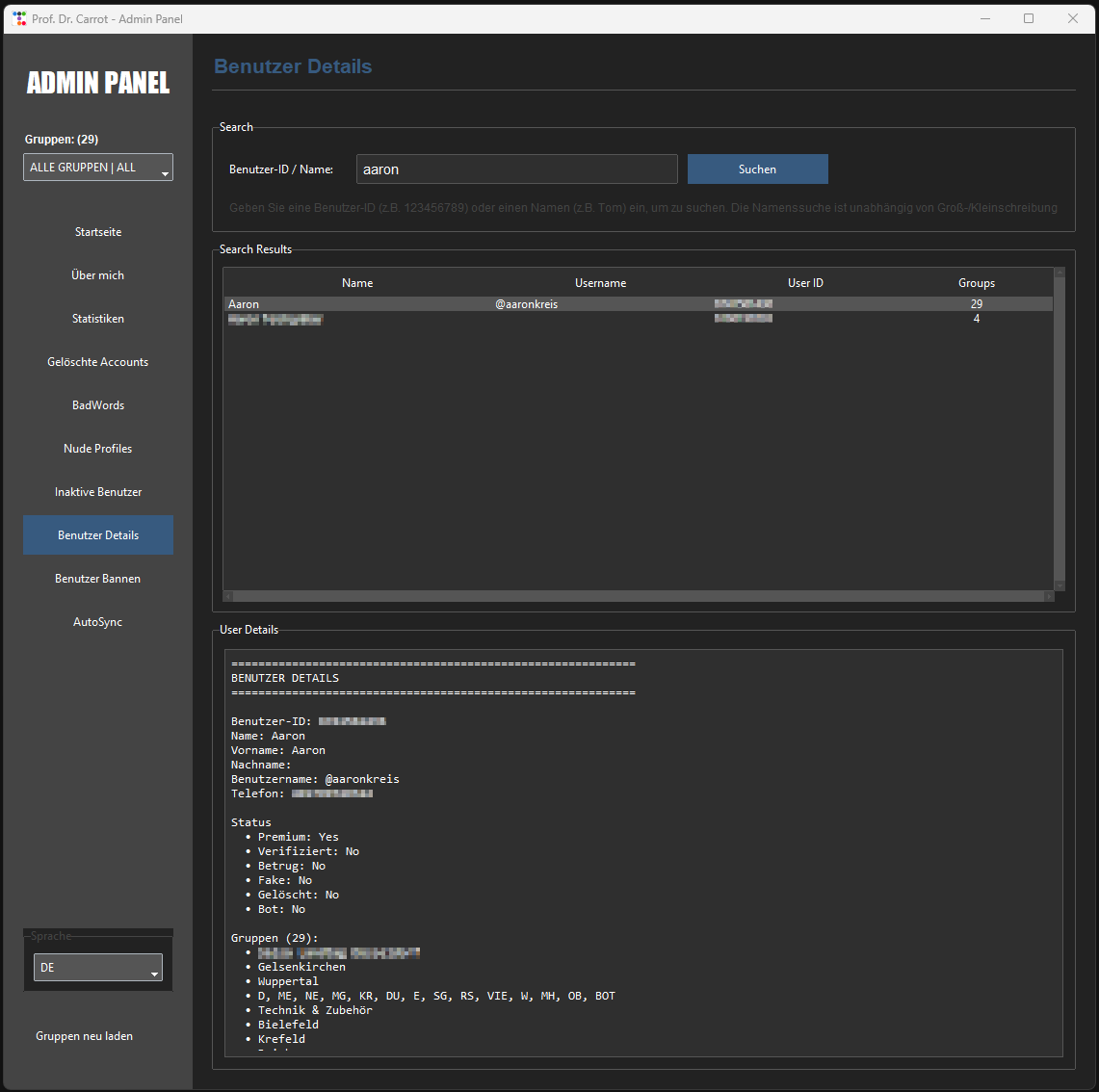
Before sanctions can be imposed on a troublemaker, they must be uniquely identified, which is often difficult when users frequently change their display names. In this area, the administrator can specifically search by a name and immediately receives the immutable user ID displayed, which unequivocally identifies the account. This ID is the crucial key for securely marking the user in the next step and managing or banning them across all groups without risk of confusion.
Ban Users
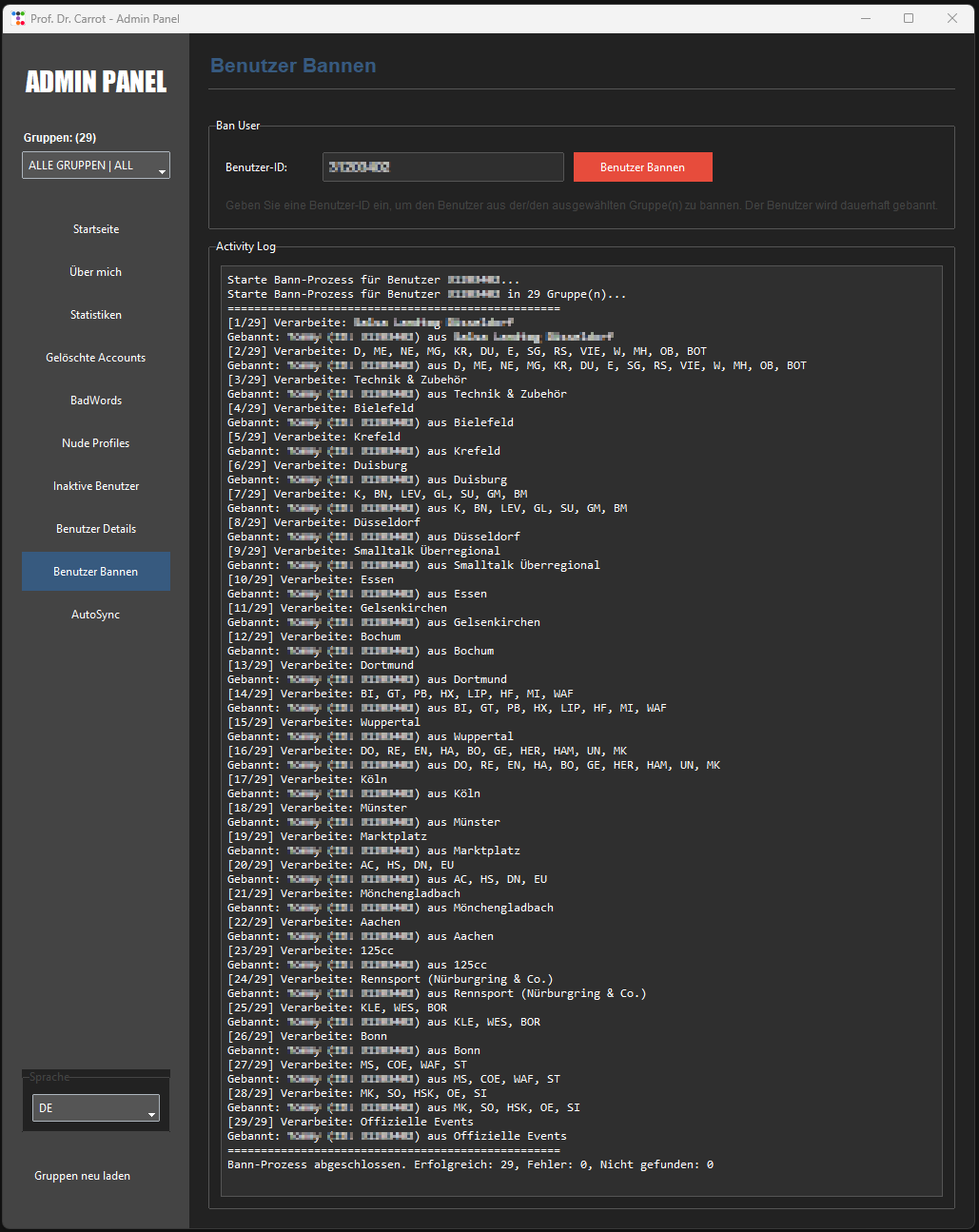
When a spammer or troll becomes noticeable in one group, they are usually also a threat in other groups of the network that must be neutralized quickly and decisively. The function uses the previously determined ID to sequentially remove the user from all 29 connected groups without the admin having to open and edit each group individually. The system processes the list in the background and logs each ban operation in the protocol, massively reducing administrative effort and immediately restoring security across the entire network.
AutoSync
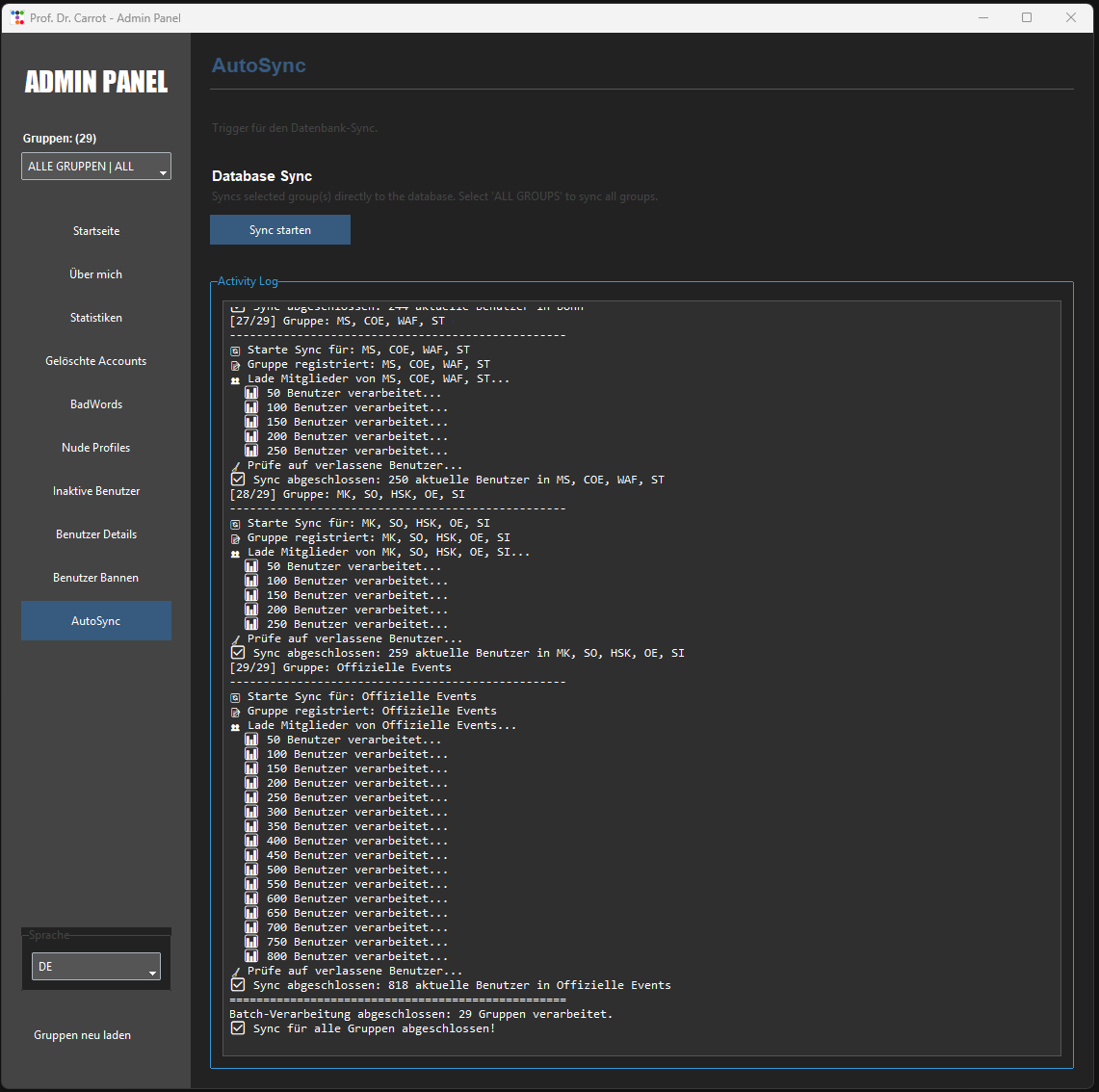
To ensure that all analysis tools and statistics deliver precise results, an absolutely current data set is essential, which is why the AutoSync module serves as the technical foundation of the entire application. Since member lists in an active network dynamically change through constant joins and leaves, this function synchronizes the local temporary database with the live data from Telegram servers. In the process log, you can observe in detail how the tool systematically goes through all 29 groups and downloads the member lists in efficient batches to respect Telegram’s API limits and avoid overloads.
Conclusion
The Prof. Dr. Carrot Admin Panel project impressively demonstrates that creating complex software solutions is no longer reserved exclusively for trained programmers but becomes accessible to everyone through the proper use of AI tools. What began as a vision for more efficient community management turned into a robust desktop application through dialogue with Gemini and implementation via Cursor. The shift from manual routine tasks to automated processes such as AI-driven image recognition or global user management illustrates the enormous potential of this new kind of software development. Ultimately, this client proves that the boundary between idea and finished product has been almost completely dissolved by artificial intelligence, enabling administrators not only to manage their communities but to lead them professionally based on real data and proactive security mechanisms.