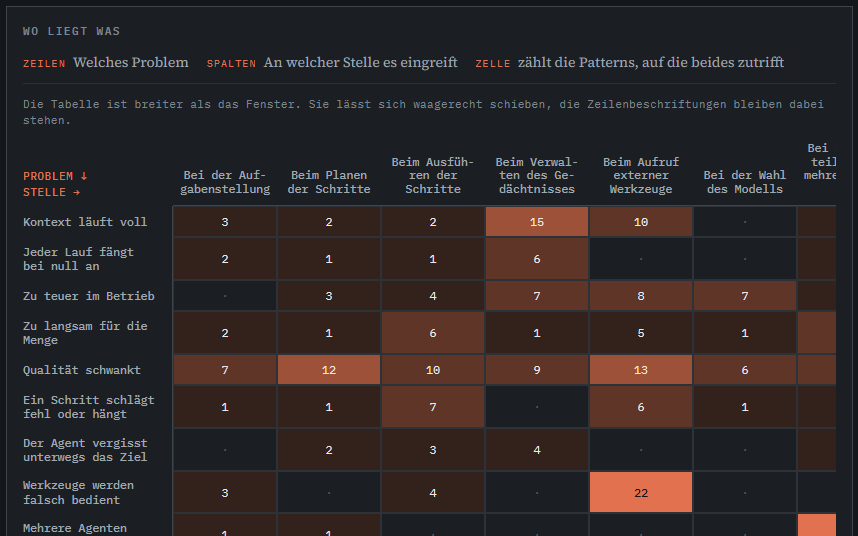
This post describes the project agentic-patterns.aaron.de: A German language catalog of design patterns and an interactive solution matrix designed to address recurring challenges when building agentic applications.
Introduction
Anyone building complex AI systems today, such as the multi agent platform DocAgents.de, quickly realizes that moving from simple prompt chains to autonomously operating agentic applications is extremely demanding. In theory, autonomous systems sound like the perfect solution. In practice, however, developers constantly stumble upon unexpected behavior, infinite loops, hallucinations, or faulty tool calls.
Anyone aiming to build professional agentic systems and deploy them successfully into production must be aware of these numerous hurdles right from the start:
- Non deterministic behavior: Agents make decisions that can change unexpectedly even with identical input.
- Cascading errors: A small mistake in a sub agent can propagate uncontrolled throughout multi agent systems all the way to the final result.
- Context loss and tool misuse: Agents forget instructions or invoke tools using incorrect parameters.
- Cost and latency explosions: Uncontrolled re evaluations or infinite loops cause token costs and response times to skyrocket rapidly.
There are countless places where agents do not work as expected. While patterns do not offer a guaranteed fix for a flawless system, they provide essential guidance.

What Is the Agentic Patterns Project?
Agentic Patterns is a curated, German language knowledge base and architectural tool for design patterns in the domain of agentic application development.
The site is built upon the pattern collection from agentic-patterns.com, but goes far beyond a mere translation:
- In depth explanations: Each design pattern includes a detailed problem statement, a concrete solution, prerequisites, and specific risks.
- Practical presentation: Technical terms and concepts are explained clearly without assuming prior knowledge as given.
- Focus on real challenges: Instead of simply praising best practices, every pattern transparently highlights the risks and pitfalls in practice.
- Curation and refinement: Redundant patterns have been systematically removed and consolidated to eliminate duplicate entries and maintain focus on the truly essential core patterns.
Navigating with the Interactive Matrix
The core feature of the site is its Matrix view. Instead of scrolling through cluttered lists, the matrix enables a targeted search for matching patterns:
- Problem oriented filtering: Cross referenced axes allow filtering by the specific problem to be solved alongside the current technical constraints.
- Multi dimensional mapping: Patterns are not locked into a single rigid category. Since a design pattern often addresses multiple challenges simultaneously, it appears flexibly across all relevant intersections within the matrix.
- Patterns at a glance: Looking for a solution to handle loss of control during tool calls, unreliable context, or feedback loops? The matrix guides you straight to the right architectural pattern.

By studying these design patterns, it becomes clear why AI systems fail at specific stages and which architectural safeguards (guardrails, human in the loop, self correction, state management, etc.) can be implemented to mitigate those risks.
Conclusion
Whether you are developing complex research agents, automated workflows, or knowledge graph systems like DocAgents.de, reinventing the wheel every time wastes time, effort, and budget.
Design patterns are not a magic cure and do not automatically guarantee a functional system. However, they provide proven approaches to recurring problems.
With agentic-patterns.aaron.de, you have a well structured tool to systematically learn from typical failure modes, weigh potential risks, and build agentic applications on a solid foundation from day one. Explore the matrix, identify your current bottlenecks, and build more reliable AI systems!