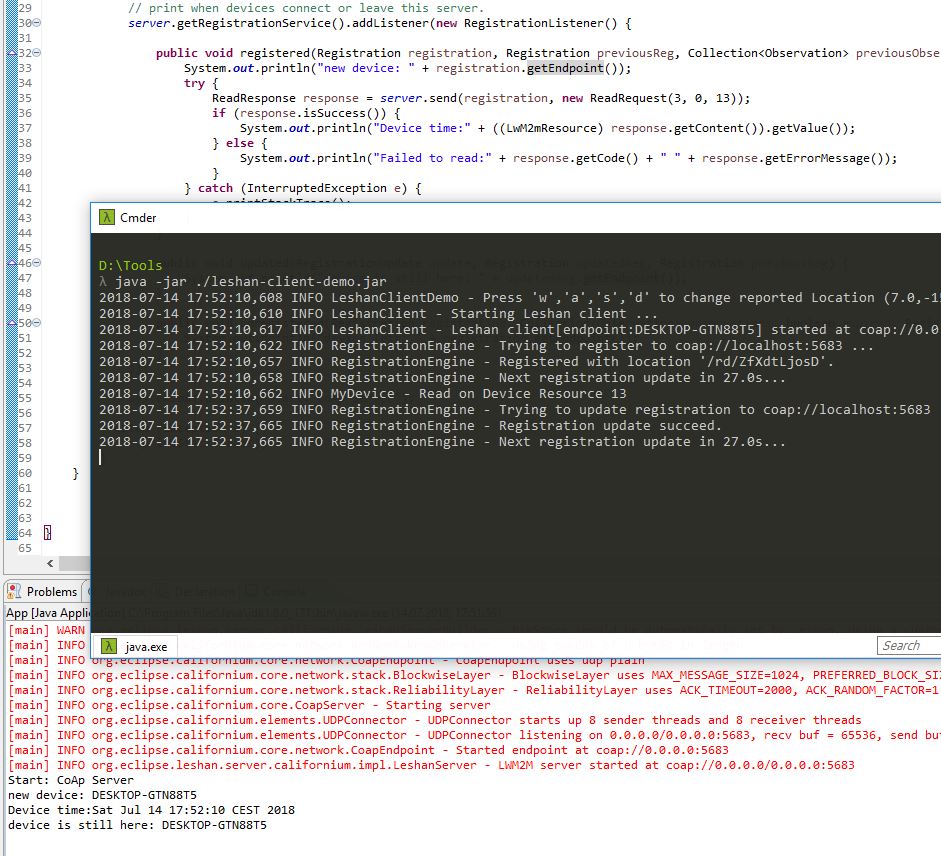
CoAP: Specification Summary (high level)

Constrained Application Protocol (CoAP) CoAP is an Internet application protocol specified in RFC 7252. The protocol is used for communication of devices ’nodes’, e.g. embedded devices, that consume very little energy (low-power) and operate in networks with increased data loss (lossy networks), for instance IPv6 over Low-Power Wireless Personal Area Networks (6LoWPANs). CoAP can also be used within Internet-based networks for mobile communication via SMS. CoAP is primarily used in the context of the Internet of Things (IoT) and Machine-to-Machine (M2M), as device data/sensor data of small size is usually transmitted. Since this type of data is transmitted at regular intervals (cycles), individual (lost) data packets have no significant impact on the processing systems or applications, such as an IoT platform that processes and/or graphically displays the corresponding sensor data (temperature, rotation speed, etc.). ...
July 12, 2018 Β· Aaron

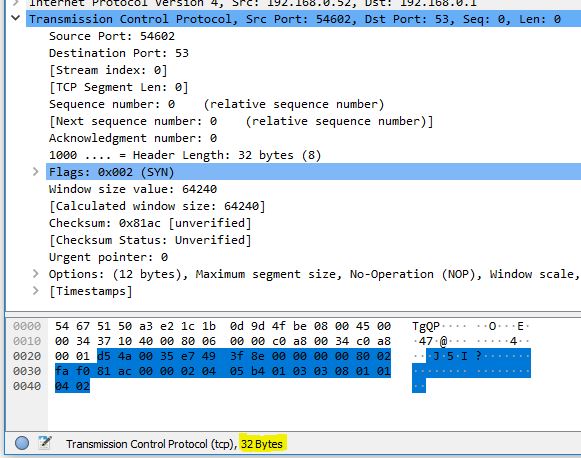
Wireshark Tutorial

Wireshark is a free program for analyzing and graphically presenting data protocols (sniffer). Such data protocols are used by computers on various communication media such as the local network or USB. Capturing the communication can be useful for troubleshooting or evaluating the content of the communication. Wireshark displays both the protocol headers and the transported content during a capture. The program relies on the output of small helper programs like pcap or usbpcap for the graphical presentation, in order to capture the communication content on the respective transmission medium. [wikipedia] ...

July 12, 2018 Β· Aaron

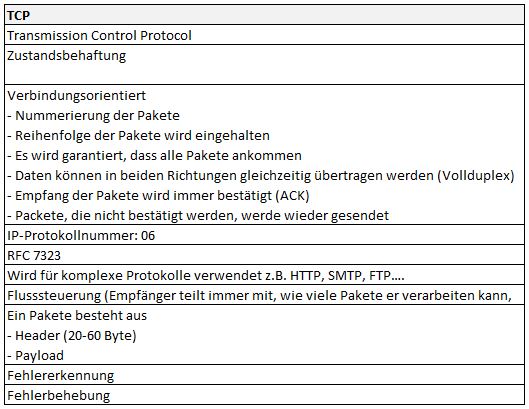
DTLS (TCP vs. UDP)

Transport Layer Security (TLS) known as Secure Sockets Layer (SSL) is an encryption protocol (based on x.509) for secure data transmission. Datagram Transport Layer Security (DTLS) is based on TLS and uses UDP instead of TCP. The difference between TLS and DTLS is equivalent to the difference between TCP and UDP. TLS requires the reliability of the data, among other things for decrypting data. If, for example, the data packets arrive out of order, TLS will not be able to perform an integrity check, since the check involves the sequence number of the packets, i.e. after packet N, packet N+1 is expected. ...

June 23, 2017 Β· Aaron